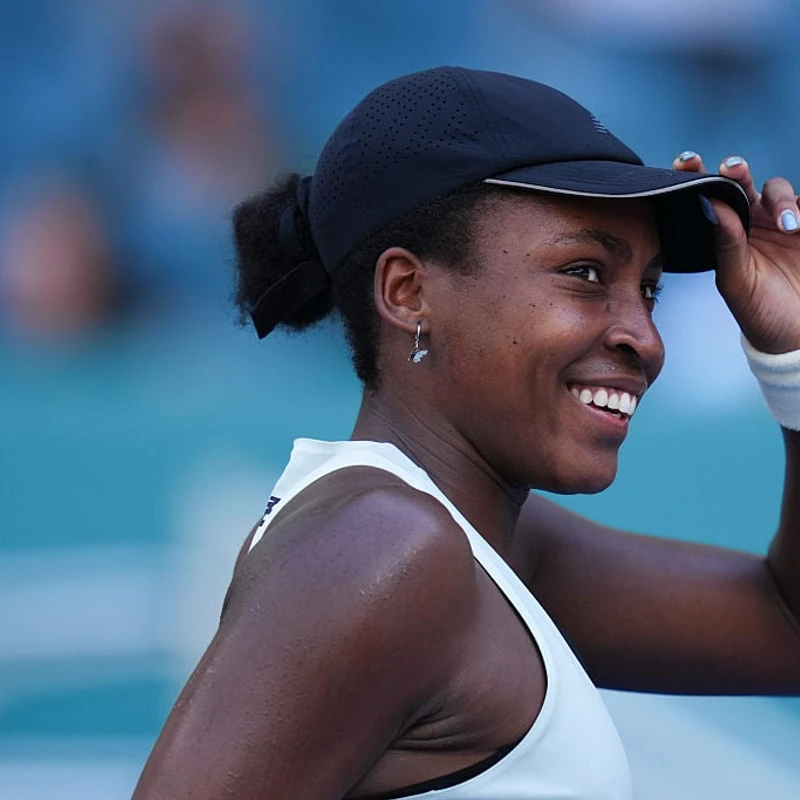
Despite the widespread celebration of the natural hair movement and media that champions embracing coils, kinks, and curls, Black social media timelines are frequently reignited by conversations policing these very textures. The latest instance involves tennis star Coco Gauff and her recent Miu Miu campaign, proving that discussions around natural hair acceptance are far from over.
The Miu Miu Campaign and Online Reactions
While promoting Miu Miu’s “Vivant” bag, Gauff was photographed on the tennis court sporting her natural coils in a bun. The brand’s focus may have been on the bag or the styling, but social media’s attention quickly shifted to Gauff’s hair. Unlike the conventionally slicked-back buns often seen, Gauff’s hairstyle embraced her natural texture, opting out of the heavy gel and tension typically used to achieve a super-sleek look.
This choice led to Gauff becoming the target of social media “jokes” and critiques. Comments likened her hairstyle to historical figures or questioned the styling choices, implying it wasn’t polished enough. This reaction highlights a persistent issue: the policing of Black women’s hair, even in spaces that claim to celebrate natural beauty.
Gauff’s Response: Protecting Her Hair and Representing
Gauff addressed the discourse in a TikTok video, explaining her choice. She noted that achieving a super-slick bun can be tedious and damaging to her hair, especially given her active tennis career. “I do play tennis, so most of the times when I’m wearing a bun, I choose to allow my hair to be and present in its 4C self because I do have 4C hair and I don’t want it to be super slick back because it’s just not good for my hair,” she explained.
She emphasized that she wouldn’t apologize for her hair’s appearance, wanting other girls with similar hair textures to feel represented. “Your hair is literally fine the way it is. My hair was good enough for a high-fashion brand like Miu Miu… So if my hair 4C is good enough for that, then yours is good enough to do whatever you need to do,” Gauff stated powerfully.
The Exhausting Cycle of Hair Policing
Gauff’s need to explain her hairstyle underscores a larger, exhausting pattern of policing Black women’s hair. While legislation like the CROWN Act aims to combat discrimination, cultural attitudes lag behind. The constant critique, even when embracing “natural” hair, reveals a disconnect between societal acceptance and the reality of managing textured hair.
The author points out that social media often attacks Black women’s choices, and hair, being an uncontrollable aspect of identity, becomes a particularly personal target. Hair is more than just strands; it’s autonomy and self-expression, whether styled as an afro, braids, locs, twists, or a bun that doesn’t conform to a narrow standard. The validity of these choices should not be up for debate.
- Coco Gauff’s natural hairstyle in a Miu Miu campaign faced online criticism.
- Critics questioned her bun, which didn’t adhere to conventional ‘slicked-back’ standards.
- Gauff explained her choice was to protect her 4C hair from damage.
- She aimed to represent girls with similar hair textures and promote self-acceptance.
- The incident highlights the ongoing policing of Black women’s hair and the need for genuine acceptance.
Gauff’s message to young Black girls is clear: embrace your hair in whatever way you choose – straighten it, perm it, wear it as an afro, braids, cornrows, or a bun. The confidence to do so, she argues, is essential for navigating a world that often projects insecurities onto others. Ultimately, for Black women, confidence isn’t optional; it’s a necessary tool to move through criticism and show up authentically.
What are your thoughts on the discourse surrounding Coco Gauff’s hairstyle? How important is it to embrace natural hair without judgment? Share your perspective in the comments below!
Leave a Reply