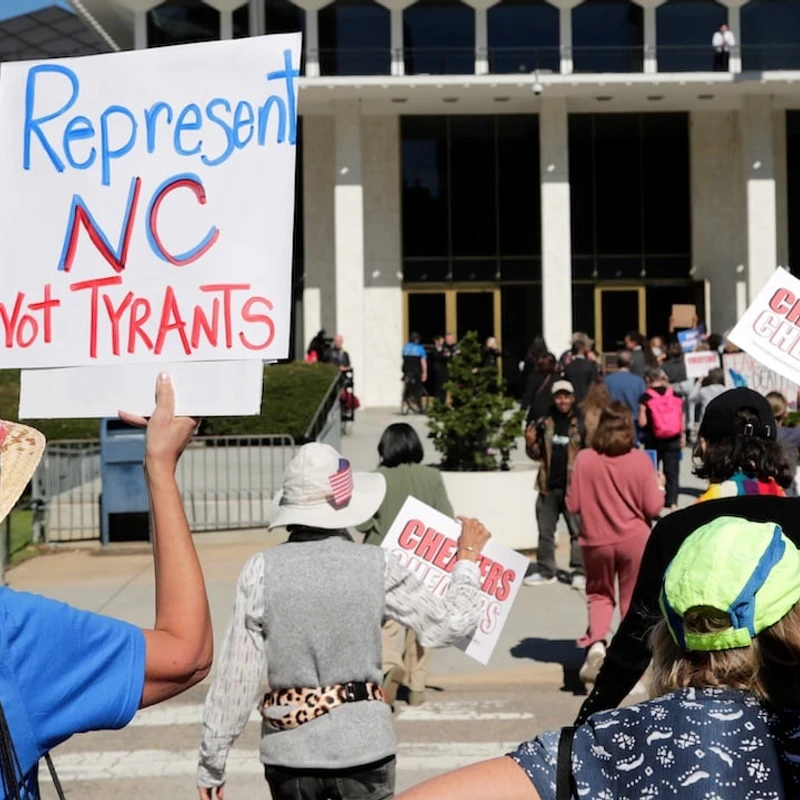
In a significant development for the upcoming 2026 elections, a federal three-judge panel has allowed North Carolina to proceed with a newly drawn congressional map. This map is designed to give Republicans an advantage by flipping a crucial swing seat, a move that’s part of a broader redistricting effort reportedly influenced by former President Donald Trump.
Targeting the State’s Only Swing Seat
The controversial map specifically targets North Carolina’s sole swing seat, currently held by Democratic U.S. Rep. Don Davis. Davis, an African American representative, serves over 20 northeastern counties, and this district has a long history of being represented by Black members of Congress for more than three decades. The judges unanimously denied requests for preliminary injunctions after a mid-November hearing.
This decision follows a separate ruling where the same judges upheld other redrawn U.S. House districts enacted by GOP state lawmakers in 2023. Those districts were used in the 2024 elections, contributing to Republicans gaining three additional congressional seats.
Trump’s Redistricting Push and Partisan Battles
Breaking with tradition, former President Trump reportedly directed GOP efforts in North Carolina and other states to redraw maps mid-decade, aiming to prevent Democrats from regaining control of the House in the upcoming midterms. Democrats need only a few seats to achieve this and potentially impede Trump’s agenda.
This isn’t an isolated effort. Republican-led states like Texas, Missouri, and Ohio have also adopted new districts to boost their chances. Conversely, California voters approved maps favoring Democrats, and Virginia’s Democratic-led assembly is pursuing redistricting through a proposed constitutional amendment. While many lower courts have initially blocked such initiatives, the U.S. Supreme Court’s conservative majority has often put those rulings on hold.
Arguments and Criticisms of the New Map
North Carolina’s Republican-controlled General Assembly gave final approval to the map on October 22nd, without requiring Democratic Gov. Josh Stein’s consent. Republican Senate leader Phil Berger hailed the court’s decision as thwarting the ‘radical left’s’ attempts to circumvent the will of the people in a state that has voted for Trump in recent presidential elections.
However, critics like Bob Phillips, Executive Director of Common Cause North Carolina, condemned the ruling, calling it a blessing for what will be the most gerrymandered congressional map in state history. He argued it intentionally retaliates against voters in eastern North Carolina for supporting candidates not preferred by the majority party.
Legal Challenges and Concerns
The ruling addresses two lawsuits. One, filed by the state NAACP, Common Cause, and voters, argued the map unconstitutionally targeted North Carolina’s ‘Black Belt’ and Democratic-voting areas. The second lawsuit questioned the use of five-year-old Census data for mid-decade redrawing, potentially violating the Constitution’s one-person, one-vote guarantee, and alleged mapmakers relied on race unconstitutionally.
Attorneys for the Republican lawmakers countered that their map-drawing intentions were political, not racial, and part of a ‘nationwide partisan redistricting arms race.’ They disputed claims of old Census data use and retaliation, citing Supreme Court precedent.
Impact on Representation
Republicans currently hold 10 of North Carolina’s 14 House seats, largely due to the 2023 map. They aim to flip an 11th seat with this latest redrawing, particularly impacting the 1st and 3rd Districts. The new map reportedly reduces the Black voting-age population in the 1st District from 40% to 32%, with counties having significant Black populations being moved to the 3rd District.
What are your thoughts on this redistricting decision and its potential impact on North Carolina’s representation? Share your views in the comments below!
Leave a Reply