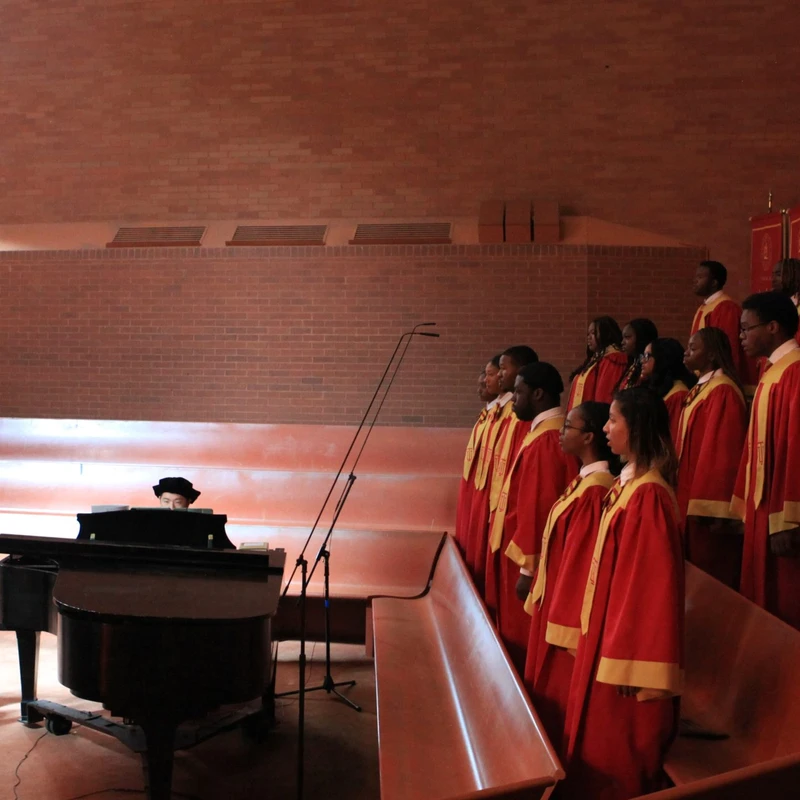
Step into the rich history of Black architecture at the National Building Museum in Washington, D.C., where a captivating new exhibit shines a light on Tuskegee University’s enduring legacy. “The Tuskegee Chapel: Paul Rudolph x Fry & Welch” exhibition delves into the university’s architectural journey, starting with its foundational figure, Robert R. Taylor, the nation’s first accredited Black architect.
A Legacy Built on Collaboration
The exhibit, running since late February, highlights the significant collaboration between renowned architect Paul Rudolph and former Tuskegee faculty members Louis Fry Sr. and John Welch. Their work in the late 1960s led to the redesign and construction of the university’s chapel building, replacing the original 1898 structure designed by Robert R. Taylor, which was tragically lost to fire.
Dr. Kwesi Daniels, head of Tuskegee’s architecture department, emphasizes that the development of the second chapel was deeply rooted in the institution’s architectural heritage, beginning with Taylor’s vision. Taylor’s influence was so profound that by 1930, he had designed nearly every building on the campus, including those that housed Dr. Booker T. Washington and scientist George Washington Carver.
More Than Just Buildings
As Dr. Catherine Armwood, dean of the Robert R. Taylor School of Architecture and Construction Sciences, aptly puts it, “At Tuskegee, buildings are never just objects; they are classrooms and sanctuaries.” The chapel, in particular, is recognized not only as a spiritual center but also as a “living laboratory” where students learn to design and build with purpose, honoring the strength of their past.
This exhibition follows its successful run at the Yale Architecture Gallery in 2025 and coincides with a retrospective of Paul Rudolph’s work at the Metropolitan Museum of Art. Curator Helen Brown Bechtel discovered a deep, long-standing relationship between Rudolph and Tuskegee’s fourth president, Dr. Luther Hilton Foster Jr., which served as a gateway to uncovering the rich story of American architectural education at the university.
The Foundation of Architectural Education
Robert R. Taylor, the first Black graduate of MIT in 1892, was recruited by Booker T. Washington to establish Tuskegee’s architecture program. He brought invaluable expertise, teaching students not just the physical labor of building but also the design concepts that would shape the campus and train future architects. This educational model produced influential figures like Vertner Woodson Tandy, New York state’s first registered African American architect.
The exhibit highlights the collaborative spirit, mirroring the partnership between Rudolph, Fry, and Welch. It explores the significance of brick in Tuskegee’s architecture, the chapel’s connection to its surroundings, and the crucial contributions of Fry and Welch. As MIT’s Head of Architecture Nicholas de Monchaux notes, Taylor is the “root of our long standing collaboration with Tuskegee now.”
A full-scale replica sculpture of the chapel’s original brickwork, created by Tuskegee and MIT alumnus Myles Sampson, further illustrates the connection between tradition and innovation. This piece demonstrates how the story of Tuskegee’s architectural legacy continues to evolve with new generations of designers.
The exhibition, which runs until January 2027, offers a vital opportunity to honor the pioneers who not only built Tuskegee’s campus but also extended their knowledge and skills to build Black communities across the nation. It’s a powerful testament to the enduring impact of Tuskegee’s architectural program.
Have you visited the Tuskegee Chapel exhibit? What aspect of Tuskegee’s architectural history fascinates you the most? Share your thoughts in the comments below!
Leave a Reply