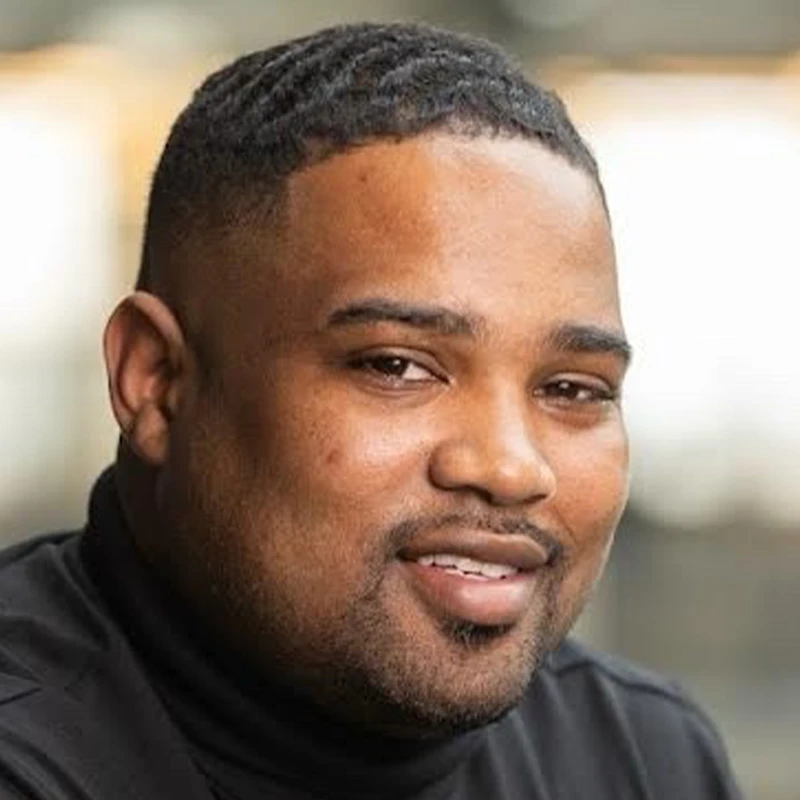
Imagine being able to detect dangerous germs on surfaces in just minutes, without needing a lab. That’s the reality being brought to life by Darrell Marshall, a Detroit-based founder and scientist who has developed an innovative AI-powered device designed to do just that.
From Rough Beginnings to Scientific Pursuits
Marshall’s journey into science began in his childhood in Detroit, a city he describes as having a “pretty rough” upbringing during the ’80s and ’90s. Despite the challenges, his single mother instilled in him a belief that he could achieve anything, with science becoming his guiding star. This unwavering support led him to Wayne State University, where he earned a bachelor’s degree in analytical chemistry.
He further honed his expertise with a doctorate in bioanalytical chemistry from the University of Nebraska-Lincoln, focusing his thesis on using advanced techniques to study infectious diseases. After gaining experience at university-based startups and a medical research company, Marshall’s path took a deeply personal turn.
A Personal Tragedy Sparks Innovation
In 2021, Marshall experienced a profound loss when his grandfather passed away from a hospital-acquired infection after a month on a ventilator. This traumatic event fueled his determination to prevent other families from enduring similar grief. He realized that a staggering 90% of germs are spread via surfaces, and he believed a solution was possible.
This realization led to the conception of his biotech startup, Total Analysis, co-founded with Kristin Klaus (COO) and Fatema Bhinderwala (CTO). Marshall’s vision was clear: develop a way to detect germs on surfaces early enough to prevent their spread, particularly in high-risk environments like hospitals serving Black and brown communities, where infection rates can be alarmingly high.
Introducing Helios-1: The Future of Pathogen Detection
The result of this dedication is Helios-1, an AI-powered portable device designed for on-site pathogen detection within minutes. What sets Helios-1 apart is its ability to provide results without the need for a laboratory or specialized training. Initially, the device will target the agriculture and healthcare sectors, with a projected launch in Q4 2026.
Helios-1 works by detecting the unique molecular fingerprints of bacteria, which include proteins, peptides, and DNA. These are then cross-referenced against Total Analysis’s extensive database using machine learning. Marshall has already secured nearly $400,000 in funding, including a significant grant from the National Science Foundation, and anticipates receiving approximately $2 million more.
Looking ahead, Marshall envisions Helios-1 evolving into wearable technology, making pathogen detection as commonplace as checking your heart rate on an Apple Watch. This innovation promises to revolutionize how we approach hygiene and infection control, making our daily lives safer.
What do you think about the potential of AI in detecting pathogens? Share your thoughts on this groundbreaking technology in the comments below!
Leave a Reply