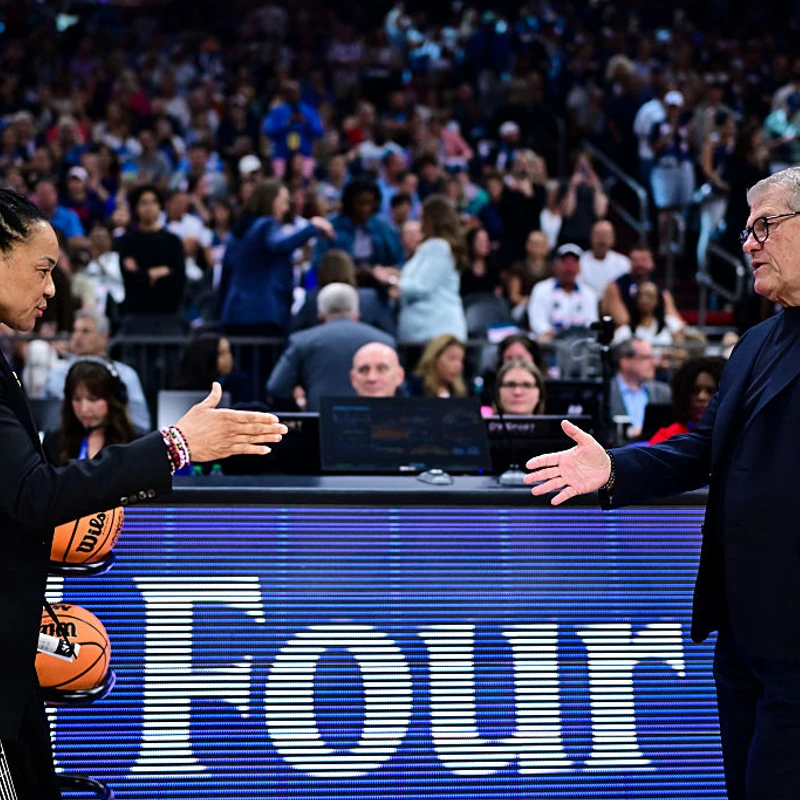
The heated exchange between UConn coach Geno Auriemma and South Carolina coach Dawn Staley during the recent national semifinal has ignited a crucial conversation. While some dismissed it as typical competitive tension, for many Black women, Auriemma’s alleged accusation and Staley’s fiery response tapped into a deeply familiar pattern of disrespect often encountered in professional settings.
More Than Just a Game
The incident began with Auriemma reportedly accusing Staley of not shaking his hand before the game. However, video evidence aired by ESPN clearly showed the two coaches exchanging handshakes. As Staley walked away, she declared, ‘I will beat Geno’s ass,’ a phrase that quickly went viral. While former player Diana Taurasi downplayed the event as mere high-level competition, the underlying dynamics resonated differently with many.
For Black women, this situation often mirrors experiences in the workplace. The narrative of having to ‘work twice as hard to be twice as good’ to achieve half as much is a reality many face. Studies, like the one from Lean In and McKinsey in 2020, highlight that Black women encounter more microaggressions and have their expertise questioned more frequently than their white counterparts.
Dawn Staley’s Trailblazing Career
Coach Dawn Staley herself is a testament to this hard work and excellence. A four-time Olympic gold medalist and decorated WNBA player, she transformed the University of South Carolina’s women’s basketball program into a powerhouse, securing multiple national championships. Her success, including winning the Naismith Award as both a player and coach, exemplifies the ‘twice as good’ standard.
Beyond her on-court achievements, Staley is known for her kindness and generosity, such as gifting Louis Vuitton perfume to opposing players. This compassionate approach contrasts sharply with Auriemma’s behavior, making his accusations seem even more out of place.
A Pattern of Dismissiveness?
Auriemma’s initial refusal to apologize and his comment that he and Staley ‘don’t have a lot in common’ further fueled the narrative. While he eventually issued a statement apologizing to the South Carolina staff and team, the lack of a direct apology to Staley was noted by many, echoing the way Black women’s contributions can be minimized or overlooked.
As author Toni Morrison wisely stated, racism often functions as a distraction, forcing individuals to constantly justify their existence rather than focus on their work. Auriemma’s focus on a trivial handshake accusation, and his subsequent lukewarm apology, served to distract from Staley’s coaching prowess and her team’s dominant victory.
The Broader Impact
This incident underscores the persistent challenges Black women face in professional environments. The stress associated with these dynamics contributes to higher rates of burnout, as noted in Lean In’s 2025 report. With women’s basketball gaining more visibility, it’s crucial to focus on the game and the athletes, rather than getting caught up in unnecessary distractions that undermine their achievements.
As the focus shifts to the championship game, the hope is to celebrate the incredible talent and dedication on display, recognizing the hard work of athletes and coaches like Dawn Staley who continue to elevate the sport.
What are your thoughts on the incident between Dawn Staley and Geno Auriemma? How does it reflect broader workplace dynamics? Share your perspective in the comments below!