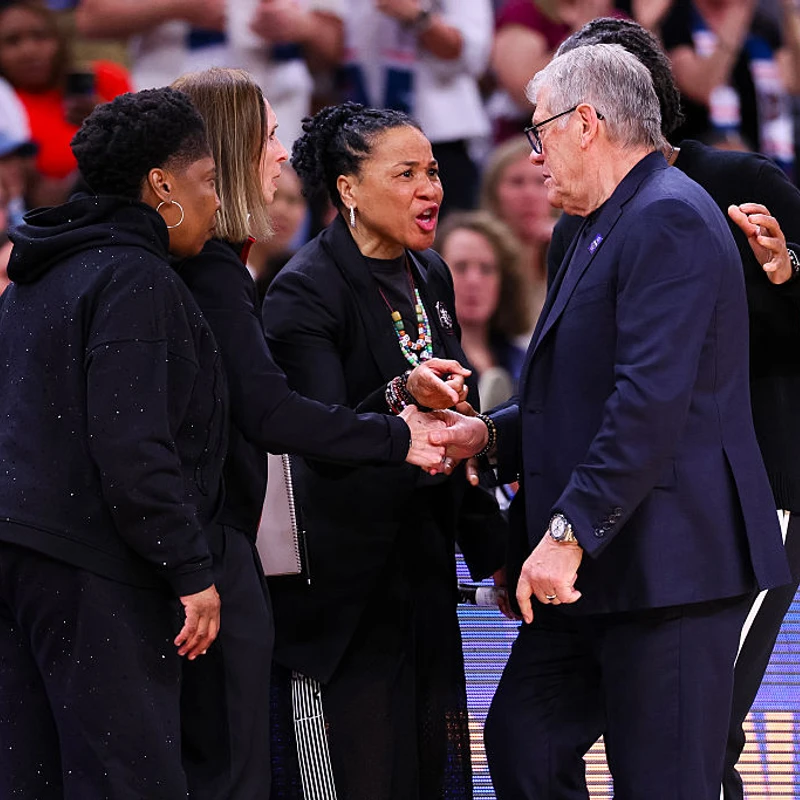
The intense moment between UConn coach Geno Auriemma and South Carolina coach Dawn Staley at the end of their national semifinal game on Friday night has ignited a crucial conversation. While some dismissed it as typical competitive friction, for many Black women, Auriemma’s actions resonated with a deeply familiar pattern of disrespect often encountered in professional settings.
A Familiar Dynamic: Accusations and Dismissal
The controversy began when Auriemma allegedly accused Staley of not shaking his hand before the game. However, video evidence aired by ESPN clearly showed the two coaches exchanging handshakes. Staley’s viral retort, ‘I will beat Geno’s ass,’ captured the frustration many felt. Even Auriemma’s former player, Diana Taurasi, attempted to downplay the incident as mere high-level competition.
But this perspective overlooks a critical element: the racial and gender dynamics at play. For countless Black women, the workplace is a landscape where hard work doesn’t always equate to equal recognition or respect. Studies, like the one from Lean In and McKinsey and Company in 2020, highlight that Black women disproportionately face microaggressions, have their expertise questioned, and are often required to constantly prove their competence—a burden rarely placed on their white counterparts.
Dawn Staley’s Trailblazing Career
Dawn Staley herself embodies the ‘twice as hard, twice as good’ mantra. A four-time Olympic gold medalist, a seven-season WNBA veteran, and a highly successful college coach, she has built the University of South Carolina Gamecocks into a dominant force. Her achievements include multiple national championships and the rare distinction of winning the Naismith Award as both a player and a coach.
Beyond her on-court success, Staley is known for her kindness and generosity. She’s gifted Louis Vuitton perfume to opposing players and consistently greets media members courtside. This compassionate approach stands in stark contrast to Auriemma’s accusatory behavior.
Auriemma’s Response and Its Implications
When pressed for comments, Auriemma initially stood by his actions, stating he didn’t feel an apology was warranted. He also made a peculiar remark about not having ‘a lot in common’ with Staley, despite their shared high-pressure profession. This dismissiveness, coming from a white male coach towards a highly accomplished Black female coach, echoes the subtle yet damaging ways Black professionals are often othered and their achievements minimized.
The subsequent apology issued by UConn, rather than directly from Auriemma to Staley, further fueled criticism. It felt like a deflection, a common tactic that, as author Toni Morrison noted, serves to distract from the real issue—in this case, Staley’s superior coaching and her team’s dominant victory. Auriemma’s focus on a triviality like a handshake served to detract from the Gamecocks’ well-deserved win.
The function, the very serious function of racism is distraction. It keeps you from doing your work. It keeps you explaining, over and over again, your reason for being. — Toni Morrison
This pattern of distraction is particularly damaging at a time when Black women are experiencing high rates of burnout and job insecurity, and when diversity initiatives are increasingly viewed as liabilities. The data shows that Black women are facing significant unemployment challenges, making these workplace dynamics even more critical.
Focusing on the Game
As women’s basketball continues to grow in visibility and competitiveness, it’s essential to focus on the athletes and coaches who are elevating the sport. The championship game between South Carolina and UCLA, featuring two phenomenal women coaches and top-seeded teams, deserves attention for its athletic merit, not for manufactured controversies.
While the ‘I will beat Geno’s ass’ line has become a rallying cry, the ultimate goal is to move beyond these distractions and celebrate the excellence on display. Let’s keep the focus on the game, the players, and the incredible women leading these teams.
What are your thoughts on the interaction between Dawn Staley and Geno Auriemma, and how it reflects broader workplace issues? Share your perspective in the comments below!
Leave a Reply