Tag: GOP

  • CBC Blocks Athlete Pay Bill Amid Gerrymandering Boycott Calls

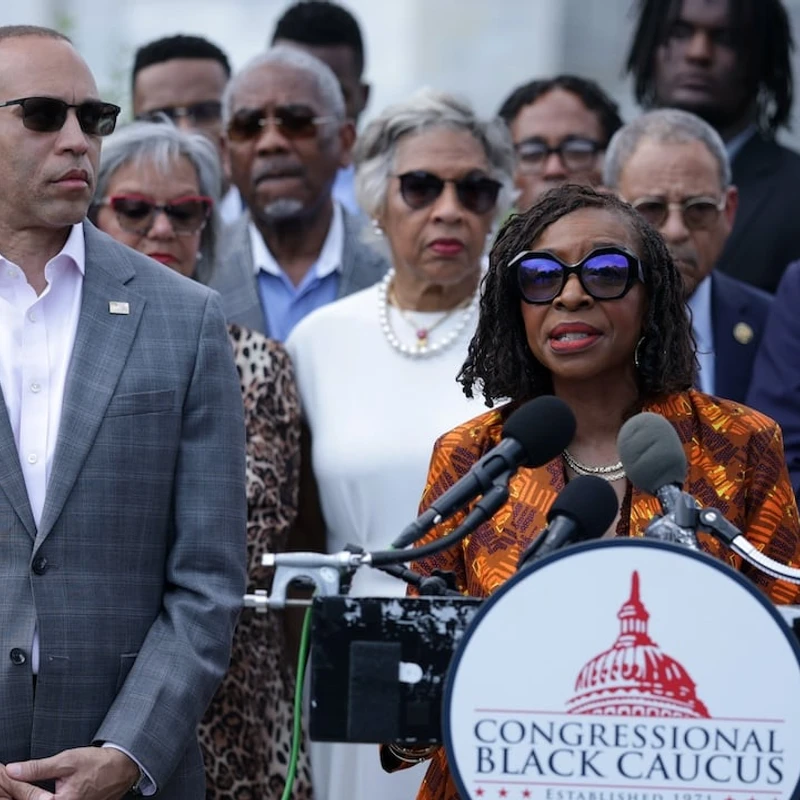
    The Congressional Black Caucus (CBC) has taken a firm stance, blocking a key bill aimed at stabilizing college athlete compensation. This move is directly tied to ongoing concerns about GOP gerrymandering and its impact on Black voting rights across the South.

    A Bold Stance on the SCORE Act

    Just a week after aligning with the NAACP to encourage Black student athletes to boycott Southern states involved in redistricting, the CBC is amplifying its message. They’ve declared they won’t support any legislation that benefits major athletic institutions remaining silent on the systematic dismantling of Black political power.

    This decision marks a significant shift, as some members had previously shown support for the SCORE Act (Student Compensation and Opportunity Through Rights and Endorsements Act). The act itself aims to create a national framework for college sports and Name, Image, and Likeness (NIL) compensation, while shielding the NCAA and universities from antitrust lawsuits.

    Concerns Over Athlete Power and NCAA Influence

    Even some Republican lawmakers, like Florida Rep. Byron Donalds, voiced concerns, arguing the SCORE Act could grant the NCAA too much control over student-athletes. The sentiment from the CBC is clear: for generations, Black athletes have fueled college athletics, yet many institutions are silent as Black voting rights face coordinated attacks.

    The caucus stated, “This is not politics as usual. This is a defining moral moment for our country.” The SCORE Act’s goal was to provide the NCAA with limited antitrust protection regarding NIL rights, transfers, and eligibility. President Donald Trump had actively promoted the bill, even contacting figures like Nick Saban to garner support.

    Expanding the Call to Action

    Without the crucial votes from the CBC, the SCORE Act was pulled from the House floor. This action follows the NAACP’s call for a boycott of Southern schools by Black student athletes, a response to the gutting of the Voting Rights Act. The CBC is now extending this call to businesses nationwide.

    Letters have been sent to over 250 companies, urging them to take a stand against GOP redistricting efforts that the CBC believes are designed to silence Black voters. This push comes nearly six years after the murder of George Floyd, a moment that spurred significant DEI commitments from many corporations.

    • Companies like Apple, Amazon, Google, and Microsoft previously pledged support for racial equity.
    • The CBC is testing whether these commitments were principle-based or merely convenient.
    • Some corporations, like Target, have faced boycotts after rolling back DEI practices.

    Rep. Yvette Clarke emphasized the responsibility of corporations: “Corporations that have profited from Black consumers, relied on Black workers, and amassed wealth in part from Black communities cannot look away while Black political power is dismantled in plain sight.”

    What do you think about the CBC’s decision and their call to businesses? Let us know your thoughts in the comments below!

  • Jeffries Criticizes GOP Over Lack of Support After Jan. 6 Rioter’s Threat

    House Minority Leader Hakeem Jeffries is calling out Republican leaders and the White House for their silence following the arrest of a January 6th rioter who allegedly threatened his life. Jeffries stated that not a single Republican has reached out to him since the arrest, highlighting what he describes as the current political environment.

    A Pardoned Rioter’s Alleged Threat

    The individual in question, Christopher Moynihan, was arrested on October 19th for allegedly sending threatening text messages about his intent to “eliminate” Jeffries. These threats reportedly occurred just before Jeffries’ scheduled appearance at the Economic Club of New York on October 20th. Moynihan has been charged with making a terrorist threat, a felony, and pleaded not guilty during his arraignment.

    Adding a layer of controversy, Moynihan had previously received a pardon from President Donald Trump in January. This pardon was among over 1,500 granted to individuals involved in the January 6th, 2021, attack on the U.S. Capitol, an event aimed at disrupting the certification of the 2020 presidential election results.

    Jeffries Criticizes Trump’s Pardons

    Jeffries did not hold back in his criticism of Trump and the Republican party regarding the pardons. He questioned how Republicans could “justify the fact that Donald Trump pardoned hundreds of violent felons on his first day in office.” Jeffries specifically mentioned individuals who “brutally beat police officers” during the Capitol attack, arguing that pardoning these felons and releasing them back into communities has led to reoffending.

    The New York congressman also pointed out the lack of contact from House Speaker Mike Johnson. When asked about Moynihan’s threats, Johnson reportedly claimed ignorance and shifted the focus to anti-Trump protests, describing “violence on the left.” Jeffries countered this by stating, “The assassination culture that’s been advanced now—this is the left, in almost every case that is advancing this, and not the right.” He urged against making the issue partisan.

    A Call for Unity and Accountability

    The incident underscores the deep political divisions and the heightened tensions surrounding political discourse and safety. Jeffries’ comments highlight a perceived lack of solidarity from Republican leadership in the face of threats against a prominent Democratic figure, especially one stemming from an event that continues to be a focal point of political debate.

    What are your thoughts on the lack of support from Republican leaders? Do you believe pardoning Jan. 6th rioters contributes to political violence? Share your views in the comments below.

  • NC GOP Targets Black Congressman’s Swing Seat

    North Carolina’s political landscape is heating up as Republican lawmakers have unveiled a proposed new congressional map. This redrawing of district boundaries is seen by many as a strategic move to bolster GOP control of Congress, potentially making it significantly harder for Democratic Rep. Don Davis to win reelection in the state’s only swing district.

    A Bid to Secure GOP Control Ahead of Midterms

    The proposed map, unveiled by state House and Senate GOP leaders, comes in response to President Donald Trump’s call to secure more Republican seats ahead of the 2026 midterm elections. With Democrats needing just three seats to potentially regain control of the House, and given the historical trend of the president’s party losing seats in midterms, Republicans are actively seeking electoral advantages nationwide.

    This isn’t the first redistricting effort in North Carolina. Republicans previously approved a map in 2023 that led to GOP candidates winning 10 out of the state’s 14 U.S. House seats in 2024, a shift from the 7-7 split under the 2022 map.

    Targeting the 1st District and Rep. Don Davis

    Based on past election results, the newly proposed boundaries appear to specifically target the 1st District, currently held by Democratic Rep. Don Davis. Davis, who is one of North Carolina’s three Black members of Congress, won his second term in 2024 by a narrow margin of less than 2 percentage points. The current 1st District includes several majority-Black counties.

    The retooled boundaries would incorporate more coastal counties while removing some inland areas, including Greene County, Davis’s home county. This adjustment aims to create a slightly more right-leaning 1st District. While other districts to the west would remain largely unchanged, the shift could potentially give Republicans a stronger chance to win 11 out of North Carolina’s 14 seats.

    Accusations of Partisan Gerrymandering

    While Republican leaders like Senate leader Phil Berger have stated the General Assembly is ‘ready to help Republicans secure Congress and move @realDonaldTrump’s agenda forward!’, Democrats have strongly criticized the move. State Democratic representatives accuse the GOP of attempting to ‘steal’ a seat won by Davis, raising concerns about unlawful racial bias in the redistricting process.

    Instead, we’re coming back to talk about redistricting because Republicans believe if they can’t win fair, they’re going to change things and cheat and win that away. — State Democratic Rep. Sarah Crawford

    Adding to the controversy, North Carolina’s state constitution prevents Democratic Gov. Josh Stein from vetoing redistricting plans, leaving the GOP majorities in the state House and Senate with significant power. This action is taking place while the state budget remains unpassed and Medicaid spending increases are undecided.

    • North Carolina Republicans have proposed a new congressional map.
    • The map targets the state’s only swing district, currently held by Rep. Don Davis.
    • The move aims to increase GOP representation in Congress ahead of the 2026 midterms.
    • Democrats accuse Republicans of partisan gerrymandering and trying to ‘steal’ a seat.
    • Rep. Davis, one of North Carolina’s Black congressmen, faces a tougher reelection bid.
    • The state constitution limits the governor’s ability to veto redistricting plans.

    Rep. Don Davis, an Air Force veteran with deep roots in Eastern North Carolina, acknowledged the concerns of his constituents, stating, ‘Eastern North Carolina families are struggling and feel that Washington, D.C., is broken.’ He emphasized his commitment to considering every option, drawing on his experience and local connections as the redistricting process unfolds.

    What are your thoughts on the proposed redistricting map in North Carolina? Do you believe it’s a fair process? Share your opinions in the comments below!

  • The Shadowy Network Flipping States Red

    You might not have heard of the Rockbridge Network, but insiders say it’s one of the most powerful conservative groups shaping American politics today. Founded in 2019 by current Vice President J.D. Vance and conservative publisher Chris Buskirk, Rockbridge isn’t your typical donor group. It functions more like a political venture capital firm, strategically investing in media, legal organizations, grassroots movements, and even planning for a conservative “government-in-waiting.”

    An Exclusive and Expensive Membership

    Getting into Rockbridge isn’t easy. Membership is strictly by invitation only and comes with a significant financial commitment: limited partners contribute $100,000, while principal partners invest a staggering $1 million. By 2024, the network had grown to about 150 members, many of whom are wealthy investors from Silicon Valley and Wall Street. With a war chest of $75 million built up for the 2024 elections, their financial power fuels conservative efforts across swing states and media platforms.

    Notable figures linked to Rockbridge include billionaire Peter Thiel, Rebekah Mercer, and the Winklevoss twins, demonstrating the caliber of individuals involved in this influential network.

    Rockbridge’s Strategic Initiatives

    While Rockbridge’s operations are intentionally low-profile, leaked information and insider accounts reveal several key initiatives. These include the “Red State Project,” which involves heavy investments in states like Arizona, Michigan, and Nevada to flip legislatures and boost GOP turnout. They also fund right-leaning media outlets and digital creators to counter mainstream narratives, strengthen conservative influence within faith-based networks, finance legal challenges on various policies, and build “parallel institutions” like think tanks to rival traditional power structures.

    • Red State Project: Investing in key states to flip legislatures.
    • Media Investments: Funding conservative media and creators.
    • Church Outreach: Mobilizing religious voters.
    • Legal Strategy: Financing lawsuits on policy and voting laws.
    • Parallel Institutions: Building alternative think tanks and training programs.

    The Power of Secrecy

    What truly sets Rockbridge apart is its commitment to secrecy. Many of the organizations they fund operate without public websites or branding, often hidden behind nonprofits, Super PACs, or donor-advised funds. This makes tracking their financial influence incredibly difficult for the public. Even their exclusive retreats, held twice a year, are shrouded in secrecy, featuring influential speakers and serving as networking and recruitment events for the conservative movement’s inner circle.

    Critics view Rockbridge as a “shadow government,” where billionaires quietly manipulate democracy through money and closed-door dealings. Supporters, however, see it as a strategic response to liberal organizing groups like Democracy Alliance. Regardless of perspective, the network’s influence on American politics is undeniable, operating behind the scenes to shape narratives and prepare conservative leaders for power.

    What are your thoughts on the influence of groups like the Rockbridge Network in shaping American politics? Share your opinions in the comments below!